
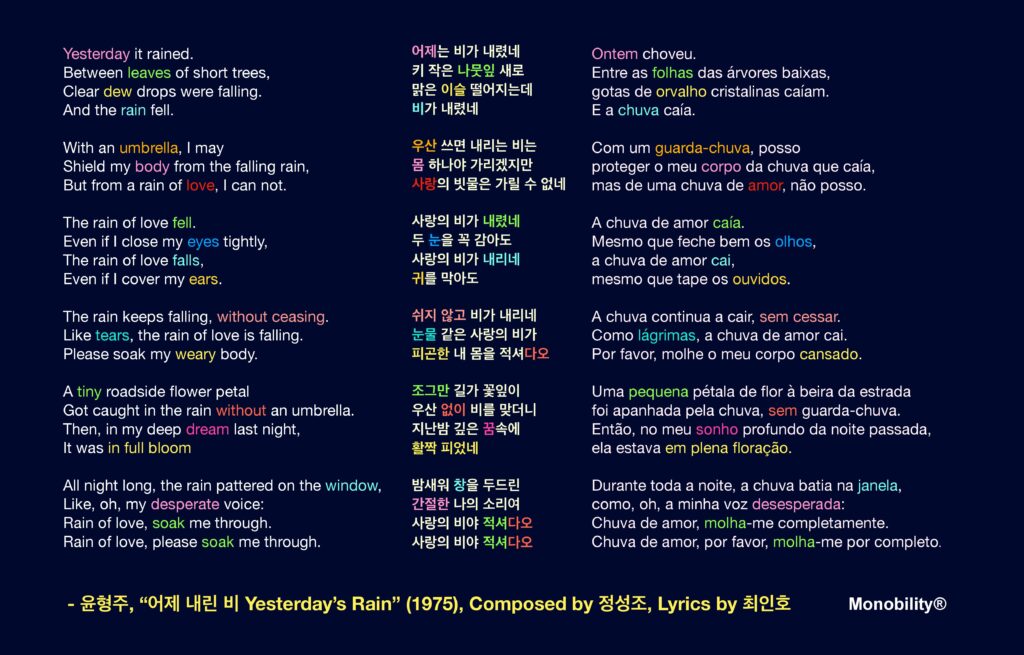
Do you need to nicely and sincerely ask someone younger than you, for example, your child, to do something in Korean? Try a little literary tenderness and end your sentence with -어/아 다오. It may sound a bit outdated in spoken Korean, but it is an absolutely popular expression in literature, letters, songs, and poems. You can use this ending as a polite and almost desperate command (imperative mood) to someone junior to you or a close friend, or even an abstract noun or a thing like “비 (rain),” as you can hear in the marvelously metaphorical song of seraphic tranquility, 어제 내린 비 Yesterday’s Rain (1975). The key effect here is that you sound elegant, so to your junior person’s ear, you also sound sincere and nice when you request something. Don’t use it with anyone senior to you, though. It would become very impolite.
As in many other verb conjugations, -어/아 다오 follows a rule called “모음조화 Vowel Harmony.”:
(1) If the verb stem’s last vowel is either ㅏ or ㅗ, add -아 to the stem and end with 다오.
- 아들아, 제발 잘 살아다오. Son, please live well. [살다 to live (stem vowel = ㅏ) => 살-아다오 = 살아다오 Please live! ]
(2) If the verb stem’s last vowel is other than ㅏ or ㅗ, add -어 to the stem and end with 다오.
- 오, 사랑의 비야, 내 마음을 적셔다오. Oh, rain of love, please soak my heart! [적시다 to soak (stem vowel = l in 시) => 적시-어다오 => 적셔다오 (contraction 시어 = 셔) Please soak! ]
(3) The verbs ending with -하다 become -해다오.
- 오 세월아, 용서해다오. Oh, Time, please forgive. [용서하다 to forgive => 용서해다오 Please forgive ]
P.S.> Did you know that many of today’s AI female vocals in Korean songs are modeled after the voice of the multi-talented actress/singer 아이유 (IU)? If you know her voice, you will notice it when you listen carefully again to the AI rendition of 어제 내린 비 as you watch her perform in the terrific rain scene from Moon Lovers: Scarlet Heart Ryeo (2016).
Music credit:
윤형주, “어제 내린 비 Yesterday’s Rain” (1975), Composed by 정성조, Lyrics by 최인호
AI vocal produced by Soul Flying Star (2026)
Monobility® Group